Barriers, Bridges and the Hard Shoulder: A Bolton Motorway Breakdown Walk-Through
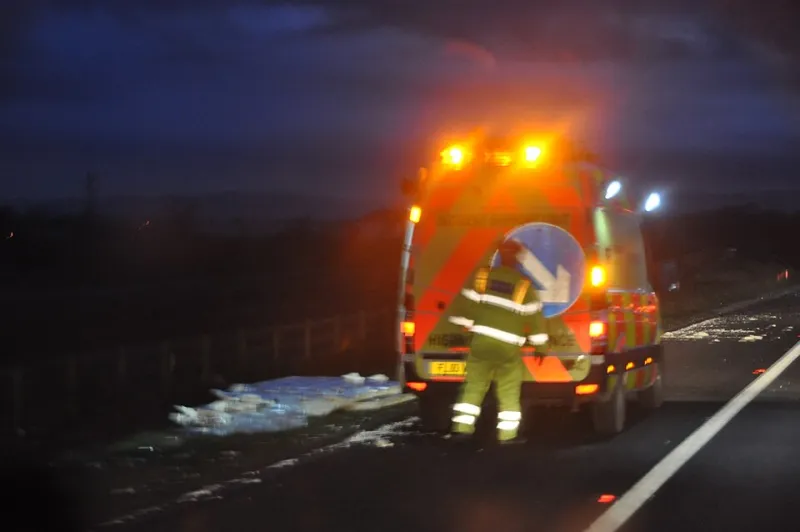
Photo: Lewis Clarke , CC BY-SA 2.0, via Wikimedia Commons
The moment your car says 'not today'
A motorway breakdown rarely arrives with a drumroll. There is a shudder, a warning light, a loss of power, or a tyre that suddenly sounds like someone is hitting it with a hammer. For Bolton drivers, that moment often happens on the M61, the M60 or the A666, and the instinct is to stop as soon as possible. That instinct is understandable, but it needs a filter. On a motorway, stopping in the wrong place can turn a bad morning into a dangerous one. The hard shoulder is not a waiting room. It is a last resort.
Aim for an emergency area, not a memory
If the car is still rolling and you have a choice, aim for a designated emergency area, a service station, or a motorway exit. On smart motorways, emergency areas are marked and spaced out; they are not a guarantee of comfort, but they are far safer than a live lane. If you can coast to a garage forecourt or leave at a junction, do it. If you cannot, get as far left as possible, switch on your hazard warning lights, and keep the steering straight. Do not slam on the brakes in traffic. Do not swerve across lanes to reach a slip road at the last second.
Where Bolton cars tend to stop
The M61 around junctions 5 and 6, the M60 near junctions 15 and 16, and the A666 are familiar places for local callouts. These are not remote moorland roads; they are busy, fast, and often dark by late afternoon in November. A car that dies on a slip road can block traffic joining the motorway. A car that stops just after a bend gives drivers very little warning. If you are on the A666, try to reach a lay-by or side road rather than the carriageway, but only if it is safe to do so. If you are on the motorway and the car will not move, the hard shoulder or an emergency area is the only realistic option.
The hard shoulder is not a safe place to sit
This is the bit worth reading twice. The hard shoulder is not designed for people to wait in. It is a narrow strip next to traffic moving at 70mph, and it offers very little protection. If you are forced onto it, exit the car on the left side, away from traffic, and stand behind the barrier if there is one. Do not stand behind the car. Do not stand in front of it. Do not try to change a tyre on the hard shoulder. Do not place a warning triangle on a motorway; that is a job for the emergency services, not for you. Keep children and pets close, and never cross the carriageway to reach a phone or a sign.
If you stop in a live lane
If the car stops in a live lane and will not move, this is a 999 situation. Put on your hazards, keep your seatbelt on, and call the emergency services. If you can safely get out and stand behind a barrier, do so, but do not put yourself in the path of traffic. On a smart motorway, a live lane is exactly what the emergency areas are there to avoid. If you cannot reach one, stay in the vehicle unless there is an immediate danger. The priority is to be seen and to be protected, not to diagnose the fault.
What dispatch needs from the first call
When you call recovery, the person on the line is not being nosy. They are trying to find you and send the right help. Give them the motorway, the direction of travel, the nearest junction, and any marker post or emergency area number you can see. If you have a what3words location, give it. Tell them the vehicle make, model, colour and registration, how many people are with you, and whether anyone is vulnerable. Say whether you are in an emergency area, on the hard shoulder, or in a live lane. If you are blocking a lane, say so. If you are not sure where you are, do not guess; read out the nearest sign or marker post.
Where to wait while help is coming
If you are on the hard shoulder, wait behind the barrier, well away from the carriageway. If there is no barrier, stand on the embankment or as far from traffic as you safely can. Keep your phone charged and keep your coat on. In November, the wind on the M61 can make a ten-minute wait feel much longer. Do not wander down the carriageway to look for a sign. Do not try to flag down passing traffic. Recovery drivers know how to find you; the safest thing you can do is stay put in a protected spot and stay reachable.
A simple sequence to remember
Hazards on. Steer for an emergency area, exit or service station if you can. If not, get as far left as possible and keep the wheels straight. Switch off the engine if it is safe. Exit on the left and get behind the barrier. Call recovery, or 999 if you are in a live lane. Give your location, direction and vehicle details. Then wait, visible and away from traffic. It is not a glamorous plan, but it is a calm one. On a Bolton motorway, calm is worth a lot.