The Quiet Fob: A Bolton Driver’s Plan for Dead Key Batteries and Locked Doors
It usually starts with a small, ordinary click that never comes. You press the fob, look for the indicators to flash, and nothing happens. Then you press it again, harder, as if the car is simply being stubborn. On a cold Bolton morning, outside a terraced house or in a busy Middlebrook car park, that little silence can feel like a much bigger problem than it is.
The good news is that a flat key fob battery is one of the most common and most solvable car annoyances around. You do not need to panic, and you usually do not need a locksmith. You need a few minutes, a bit of patience, and a rough idea of where the car’s hidden mechanical backup is hiding.
First, stop jabbing the button
Before anything else, give the fob a proper look. Is there a tiny light on it? Does the light come on weakly, or not at all? Try the spare fob if you are at home and it is within reach. If the spare works, you have your answer: the first fob needs a battery, and the car is fine.
Keyless fobs can also go a bit sleepy in cold weather, especially if they have been left in a bag or pocket for weeks. Sometimes holding the fob closer to the car, or pressing the button while the fob is right next to the door handle, is enough to wake it up. It is not a permanent fix, but it can get you into the driver’s seat.
Do not stand there for ten minutes pressing the button like a doorbell. If it is not responding, move on to the mechanical backup.
The blade is probably hiding in plain sight
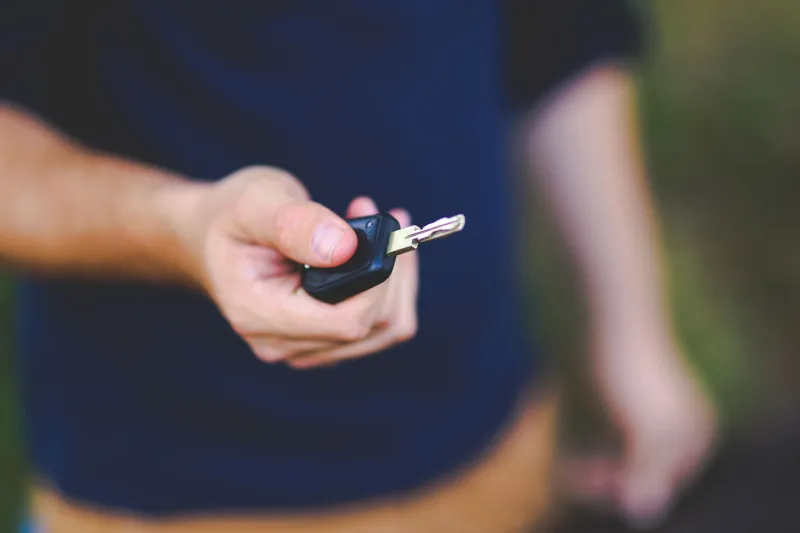
Most key fobs have a physical key blade built into them. It is not always obvious. Look for a small release button, a sliding catch, or a little tab on the side or back of the fob. Press or slide it and pull the blade out. On some fobs, the blade is already folded inside and flicks out like a penknife.
Now find the keyhole. On many modern cars it is hidden under a small plastic cap on the driver’s door handle. There is usually a slot underneath or beside the cap where you can gently prise it off with the key blade or a small flat tool. Take your time. Plastic trim clips are cheap, but they can snap if you attack them with a screwdriver and a bad mood.
Once the cap is off, use the blade to unlock the driver’s door. The alarm may sound when you open it. That is normal. Get in, close the door, and put the fob somewhere the car can read it. A noisy alarm feels embarrassing, but it is usually just the car’s way of saying it noticed the manual unlock.
If the lock feels frozen, use a proper de-icer rather than hot water. Hot water can refreeze and make things worse, and it is not kind to paintwork or rubber seals.
Getting a push-button car to accept a weak fob
Many cars with push-button start have a backup method for a flat fob battery. The exact routine varies, but the principle is the same: hold the fob against the start button or a marked sensor area while you press the brake or clutch and push the start button.
Common spots include holding the fob directly against the start button, placing it in a marked cupholder recess, or holding it near the steering column. Some cars have a slot in the glovebox or centre console. Check the handbook if you have it, but if you are stuck in the rain, try the start button first. Press the brake pedal firmly, hold the fob against the button, and give it a few seconds.
If the car still says the key is not detected, try the spare fob if someone can bring it. If not, this is the point where a recovery callout starts to make sense. A flat fob battery is a DIY job. A car that will not recognise a known-good fob may have an immobiliser or receiver issue that needs proper diagnosis.
A spare battery is cheaper than a locksmith
Most key fob batteries are common coin cells, often CR2032 or similar. Check your handbook or the old battery before buying. Keep a spare in the glovebox, still in its packaging, along with a small screwdriver that fits the fob case. Learn how your fob opens before you are stranded. Some need a coin, some need a small flat blade, and some have a hidden screw under a cover.
Replace the battery carefully. Do not force the plastic case, and do not lose the little seal or the transponder chip inside. If you are not confident, a garage can do it in minutes, but it is genuinely one of the easier jobs on a car.
It is also worth checking the spare fob now and then. A spare with a dead battery is not much of a spare.
Bolton spots that make a small problem feel bigger
A dead fob is annoying anywhere, but it is worse in a busy car park at Middlebrook, on a narrow terraced street near the town centre, or on a cold morning when you are already late. If you are in a car park, put your hazard lights on if you are stationary and blocking a lane, and stay with the car if it is safe. If you are on a residential street, try not to block driveways or the whole road while you fiddle.
On a terraced street, the pavement can be narrow and the road can be tight. Get the door open, get in, and keep the alarm noise to a minimum if you can. If the car will not start and you are causing an obstruction, call for recovery rather than trying every button combination for half an hour.
When a recovery callout is the right next step
Call for help if the manual key will not unlock the door, if the fob is lost rather than flat, if the car will not start after you have tried the backup placement method, or if you are stuck somewhere unsafe. A locksmith is the right call for lost keys, broken locks, or keys locked inside the car with no spare. A recovery service is the better call when the car is locked, immobilised, or refusing to start and you need it moved or assessed.
When you call, say what you have already tried. Mention the make and model, your location, whether the alarm is going, and whether the manual key worked. That saves time and helps the recovery team bring the right kit.
A dead fob battery is not a disaster. It is a small, mechanical hiccup with a very ordinary solution. Keep a spare battery, know where the hidden blade lives, and remember that most push-button cars have a backup trick. A little preparation now means the next quiet click does not ruin your morning.